



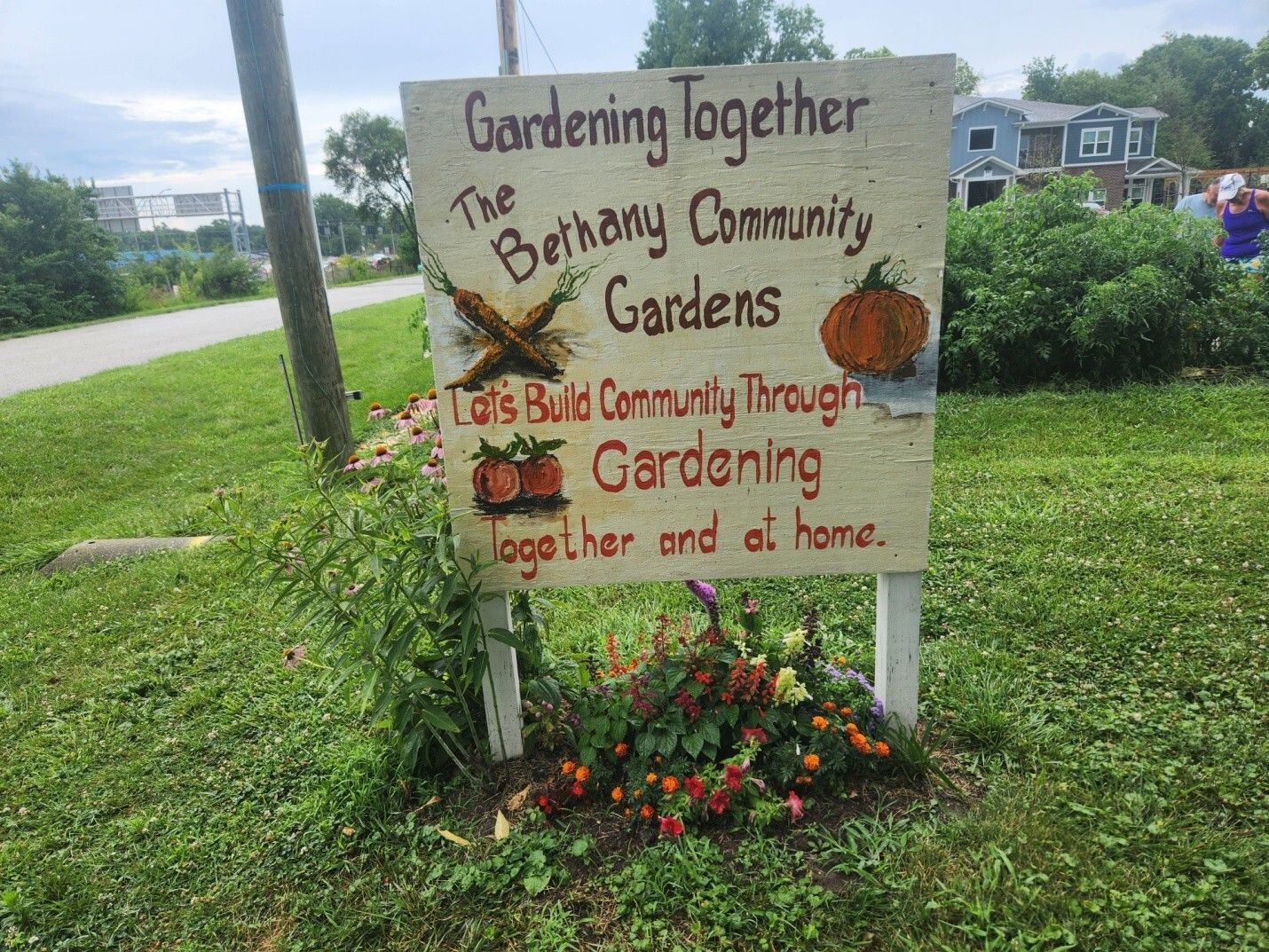
On a once underused patch of church property in Indianapolis, rows of vegetables now stretch across 10,000 square feet, with tomatoes climbing trellises, greens filling raised beds, and volunteers moving steadily through the work of tending, watering, and harvesting.
At Bethany Lutheran Church, what began as a response to neighborhood interviews has grown into an outward-facing ministry that addresses food insecurity, builds relationships, and creates new pathways for connection.
The garden’s roots trace back nearly a decade when Bethany Lutheran participated in the Indiana-Kentucky Synod’s Connect Transformational Ministry process. Congregation members conducted 24 interviews with local leaders, listening for unmet needs in the surrounding neighborhood. Those conversations revealed a reality that many neighbors just beyond the church walls were low-income and living in a USDA-designated food desert, with limited access to fresh produce. At the same time, the congregation recognized it had unused land that could be put to work.
With guidance from the Marion County Purdue Extension Service, planning began in 2017. By spring 2018, a 5,000-square-foot garden was planted. Within months, it doubled in size. Now entering its ninth growing season in 2026, the Bethany Community Garden has become a sustained, evolving ministry.
For Bethany Lutheran, the garden reflects its purpose, “Living Christ’s love within a changing world.” Fresh, organic vegetables are grown and distributed to local food pantries, while volunteers, many with no prior connection to the church, work side by side. In the process, relationships have taken root.
“It’s a whole new way of living Christ’s love,” said Pastor Nancy Nyland. “Not only in what is given away, but in the connections formed while growing it.”
Bethany’s garden is intentionally community-driven. Bruce Bye, a member of Bethany Lutheran and coordinator of the garden, works with an advisory board of 14 members who oversee operations. Eleven of those members are not part of the congregation. Together, they guide decisions on everything from planting schedules to soil care and irrigation.
The garden itself operates in three parts. Six raised beds are dedicated to the church’s early learning ministry, where young children are introduced to gardening and nutrition. Seventeen individual plots are rented to community members, who also commit to volunteering. A large community garden with 52 beds is dedicated entirely to food production for donation.
During peak season, volunteers gather twice a week to care for specific crops. In the past year alone, more than 6,000 pounds of produce were distributed. Over eight years, that total exceeds 20 tons. Of the 55 volunteers last year, 49 came from the surrounding community rather than the congregation.
“It is a true community garden,” Pastor Nyland said.
While the garden addresses food access, its influence extends further into relationship building and neighborhood connection. Partnerships have grown with the Indianapolis Neighborhood Resource Center, which recognized the garden with a Collaboration Award in 2019. That recognition later led to national honors from Neighborhoods USA, naming Bethany’s effort the 2020 National Neighborhood of the Year in the Multi-Neighborhood Partnership category.
The garden’s reach extends beyond the church grounds, connecting with neighbors through events like Lunch and Learns at the YMCA, community fairs at the University of Indianapolis, and gatherings hosted by the Marion County Soil and Water Conservation District. These moments offer entry points for people to learn about the garden and engage with its mission.
That same spirit of collaboration shapes its broader network of support. The ministry works with organizations such as the Marion County Purdue Extension, Marion County Farm Bureau, Lowe's in Beech Grove, Community Hospital South, and the Indianapolis Neighborhood Resource Center. The project is supported by groups including the Marion County Farm Bureau and Kroger. Volunteers include members of the congregation, community residents, and students from the University of Indianapolis, Roncalli High School, and Beech Grove High School, all helping sustain the work.
More recently, a simple idea from a volunteer added another layer of connection. A monthly Euchre night, launched in early 2025, brings together church members, gardeners, and neighbors for food, laughter, and conversation. For a congregation with many older members who are not able to work in the garden physically, these gatherings provide a meaningful way to remain engaged in the ministry and with the people it serves.
The crops themselves are intentionally diverse, ranging from tomatoes, peppers, and squash to leafy greens, root vegetables, herbs, and culturally specific produce grown for a local Burmese, primarily Chin, community. The advisory board regularly consults local food pantries to understand what clients will actually use, ensuring that what is grown meets real needs in the community.
At the same time, the garden serves as a classroom. Through free meals and educational workshops, neighbors are invited not only to receive food but to learn how to grow their own. These sessions help extend the impact beyond the garden itself, equipping families with skills they can use at home.
The garden also addresses food insecurity through sustainable practices. Fresh produce is supplied to local food pantries, grown without chemical fertilizers or pesticides. Methods such as cover cropping, no-till gardening, and drip irrigation support long-term soil health and environmental stewardship. This dual focus on food access and care for the land reflects a broader understanding of sustainability.
As the garden enters its ninth season, the vision remains steady: continue feeding neighbors, deepen relationships, and cultivate new leaders in the process. The work has grown beyond production into something more layered, a shared space where service, learning, and connection intersect.
For other congregations considering similar efforts, Bethany’s experience offers a practical starting point. Begin by listening, build from what you already have, and invite the community to shape what comes next.
Earlier this month, the congregation marked Rogation Sunday with a service centered on the land and the growing season. Members and community participants brought seeds, tools, and other symbols of planting to be blessed, connecting worship directly to the work happening just outside the church doors.
“Our hope is that the garden will continue to produce food for many years to come, so that we are able to help feed our neighbors,” said Bruce Bye, garden coordinator. “The purpose of our gardening classes is to encourage neighbors to have their own backyard gardens, to have healthy fresh vegetables available, and to become self-sufficient.”
