



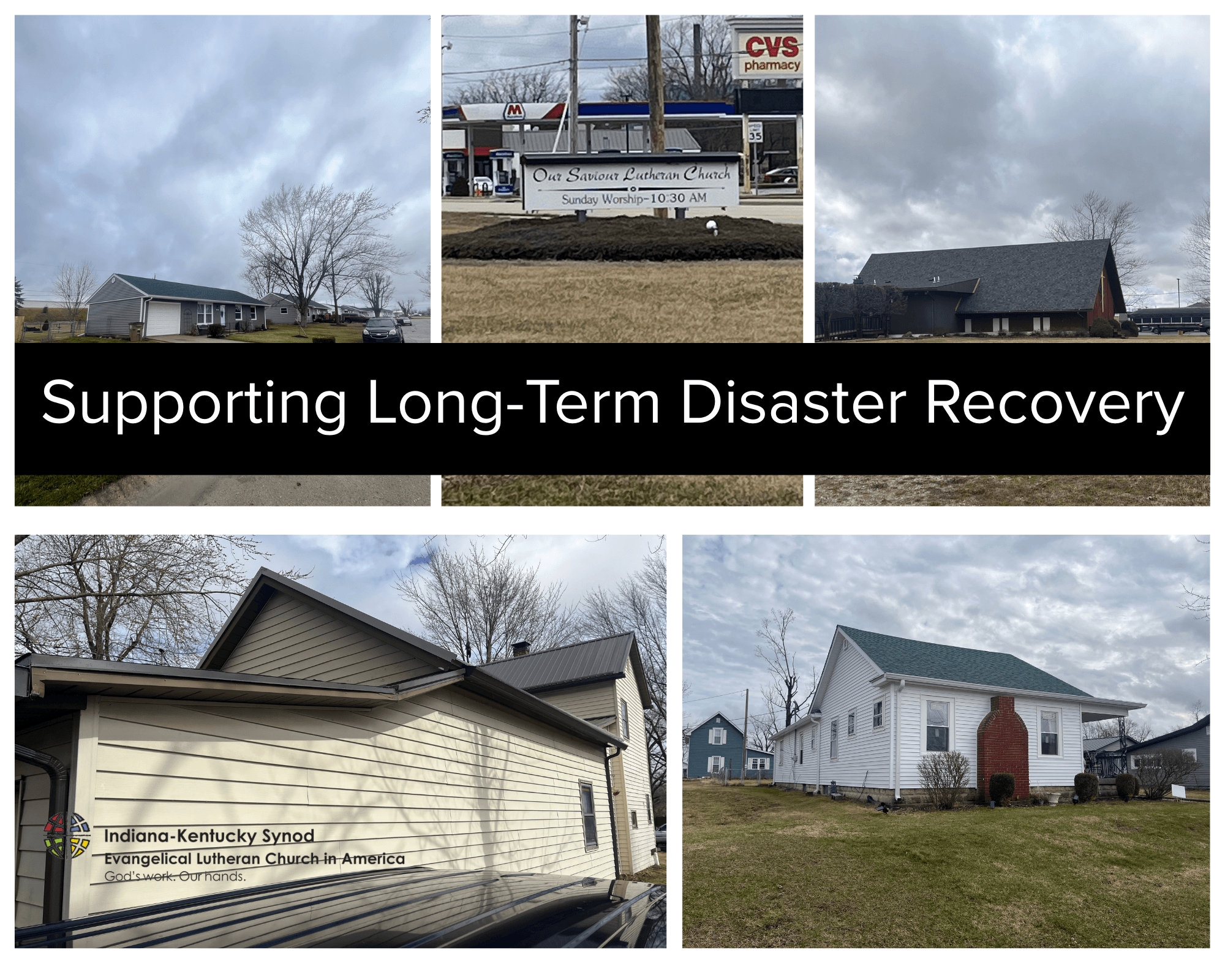
When a tornado tore through Winchester, Indiana in March 2024, it changed the community in a matter of minutes.
Monte Poling remembers it clearly.
Poling, who serves as the Synod Authorized Minister (SAM) at Our Savior Lutheran Church, remembers the destruction with striking clarity. Entire neighborhoods were torn apart in minutes. Homes disappeared. Streets became unrecognizable.
"My wife and I had been out to dinner," Poling recalled. "When we got to my mother-in-law's neighborhood, the first thing I saw was a house that was completely gone. It was just a shock."
His mother-in-law's home sustained damage, but she was safe. Looking around the neighborhood, Poling struggled to comprehend what had happened.
"One minute it's there, and the next minute it's not."
Like many people in the community, his first thought was simple: How can I help?
That question led Poling to the Winchester Long-Term Recovery Group, where he eventually became the volunteer construction manager. It wasn't a role he expected to take. His professional background included grant administration, housing rehabilitation programs, and construction-related work. He originally anticipated helping with funding and administration.
Instead, when the group needed someone to oversee construction projects, Poling stepped forward.
"If that's what you need, I'll do it," he remembers saying.
What followed was nearly two years of work helping homeowners recover from one of the most destructive events in the community's recent history.
Through local fundraising, volunteer labor, donated materials, and support from organizations like the IN-KY Disaster Response Team, the Winchester Long-Term Recovery Group was able to help homeowners complete repairs that otherwise may not have been possible.
For Poling, the work was rooted in his faith and a commitment to helping people recover.
"I know without a doubt I'm doing God's work here," he said. "It's an absolute privilege to help people at that basic level."
His role involved far more than construction oversight. He met with homeowners, assessed damage, worked alongside case managers, secured contractor estimates, coordinated volunteers, and brought projects before the recovery committee for approval.
"It's a long game," Poling said. "People want to fix everything right away, but to do it right takes time."
That reality is one of the most important lessons of long-term recovery. While emergency response happens in the hours and days after a disaster, recovery can take years. Homeowners must navigate insurance claims, financial challenges, contractor availability, and major decisions about their future, all while trying to return to some sense of normalcy.
At the height of the recovery effort, Poling said the volunteer work often felt like a full-time job.
"The phone was ringing all the time," he said.
Still, he found the work rewarding.
Looking back, Poling sees how many parts of his career prepared him for the role. Years spent working with elderly and disabled homeowners, managing housing rehabilitation grants, and evaluating homes gave him experience that proved valuable during recovery.
"I look back and think a lot of stuff was preparing me to do this," he said.
Along the way, he witnessed the challenges many homeowners faced. Some were underinsured. Others had homes that were already struggling with maintenance needs before the tornado struck.
One homeowner particularly stands out in his memory.
"She was just so thankful," Poling said. "I think she had been on her own for so long and nobody had helped her with much of anything. She was just so appreciative."
He recalls another couple whose gratitude left a lasting impression. When he visited after repairs were completed, they spent most of the conversation talking about how thankful they were that they had not been home when the tornado struck.
"They weren't talking about what happened to them," Poling said. "They were grateful they weren't hurt and grateful people were helping."
Those experiences reinforced for him how important recovery work can be, especially for people who may not have the resources to recover on their own.
The effort also revealed the strength of the Winchester community.
"It's always interesting to see how everybody comes together," Poling said. "People were showing up with chainsaws, trucks, and trailers. They just started helping."
That spirit continued long after the debris was cleared.
Local donors contributed hundreds of thousands of dollars to recovery efforts. Skilled volunteers donated labor. Contractors worked alongside recovery teams. Churches, nonprofits, and community organizations partnered to support homeowners throughout the process.
Poling was especially grateful for volunteer groups that stepped in when skilled labor was difficult to find. One Amish construction crew completed window replacements and other repairs that saved homeowners and the recovery effort thousands of dollars.
"It was a blessing," he said.
More than two years after the tornado, the recovery effort is approaching its final projects. For Poling, one of the biggest lessons has been the importance of preparation and community partnerships before disasters happen.
He hopes communities can learn from Winchester's experience by building relationships, identifying resources, and organizing local response networks before the next disaster occurs.
For Poling, seeing the recovery effort through was never really a question.
"There was no other way to do it," he said. "I was in it, and I was going to stay in it until it was done."
That commitment is what long-term recovery depends on. When disasters strike, volunteers are needed not only in the first days, but in the months and years that follow. People like Poling and the IN-KY Disaster Response Team help ensure that homeowners are not navigating recovery alone.
From coordinating repairs and working with contractors to helping families find a path forward, Poling has been part of nearly every stage of Winchester's recovery. While many people contributed to the effort, his steady presence helped carry the work from the immediate aftermath of the tornado to the final stages of rebuilding.
As Winchester closes this chapter of recovery, Poling remains grateful for the opportunity to serve alongside fellow volunteers, community partners, and homeowners.
"It's been a blessing," he said.
Support Long-Term Recovery
Recovery continues long after the initial response. Families often need months or years of assistance as they repair homes, navigate insurance challenges, and work toward stability.
The IN-KY Disaster Response Team partners with communities and people like Poling during that process, providing support, coordination, and resources that help recovery efforts move forward.
Your gift helps support long-term recovery work across Indiana and Kentucky and ensures communities have partners walking alongside them when disasters occur.
Donate today to support long-term recovery
*Please be sure to select the IN-KY Synod Disaster Response Fund at the drop-down menu
